Artificial intelligence has changed one of the oldest constrey.
A small company may have a founder handling sales, a few employees managing customers, and nobody dedicated entirely to content marketing. Writing a detailed blog post, preparing a weekly newsletter, designing social media content, creating product descriptions, and testing advertising copy can quickly become more work than the team can realistically manage.

Generative AI has started to change that equation.
A small business can now produce a first draft of an article in minutes, turn a long document into a series of social posts, brainstorm a marketing campaign, prepare several versions of an advertisement, summarize customer feedback, or rewrite a technical explanation for a general audience.
The adoption of these tools is no longer limited to technology companies. The U.S. Chamber of Commerce reported in its 2025 small-business research that 58% of surveyed small businesses said they used generative AI, compared with 40% in 2024 and 23% in 2023. Although this is U.S.-focused survey data and should not be treated as a measurement of every small business globally, the growth illustrates how quickly AI has moved into everyday business operations. es, however, the important question is no longer simply whether AI can create content.
It clearly can.
The more important questions are:
- Does AI-generated content actually help a small business grow?
- Where does it save meaningful time and money?
- What happens when every competitor can produce similar content?
- Can businesses safely trust what AI generates?
- How does AI-generated content affect SEO?
- What happens to customer trust when online content becomes increasingly easy to manufacture?
- Who owns content created with AI?
The answer is not that small businesses should avoid AI-generated content. Nor is it that every business should automate as much content creation as possible.
The smarter approach lies somewhere between those two extremes.
AI is becoming an extraordinarily useful production tool. But expertise, judgment, experience, originality, and customer trust remain human advantages.
How AI-generated content has helped small businesses
The biggest contribution of generative AI may not be that it writes better than people.
Its real contribution is that it makes content creation possible for businesses that previously did not have enough resources to do it consistently.
That distinction matters.
A large company may already have a content team, designers, advertising specialists, communications professionals, and external agencies. AI can make those teams more productive, but the company could produce content even without it.
For a small business, AI can close a much larger capability gap.
A local service provider that rarely published educational content can begin answering common customer questions online. A small e-commerce company can create better starting drafts for hundreds of product descriptions. A consultant can turn years of professional knowledge into articles without staring at an empty document for hours.
The U.S. Small Business Administration identifies content creation as one of several practical applications of AI for small businesses, alongside repetitive task automation, brainstorming, decision support, and customer service. Its guidance specifically discusses applications including blogs, job postings, product descriptions, social media content, and photo or video editing. significant in several areas.
1. AI has reduced the cost of starting content marketing
Content marketing has always carried a hidden cost.
Even when publishing a blog is technically free, someone has to:
- Choose a topic.
- Research it.
- Develop an angle.
- Create an outline.
- Write the article.
- Edit it.
- Prepare images.
- Write the SEO metadata.
- Publish it.
- Promote it.
For a small team, the real expense is often not the software. It is the number of hours required to turn an idea into something publishable.
AI can reduce the effort involved in several of these steps.
This does not mean one prompt should replace the entire content process. It means businesses can spend less time on mechanical parts of content creation and more time improving the substance.
For example, a small-business owner could record ten minutes of thoughts about a problem customers frequently experience. AI could help organize those thoughts into an outline. The owner could then add examples from real customers, correct inaccuracies, contribute personal experience, and improve the final article.
The original knowledge still comes from the business.
AI simply helps turn that knowledge into a usable format.
This is a much stronger use of generative AI than asking a tool to produce an entire article about a subject the business knows nothing about.
2. Small businesses can overcome the blank-page problem
Many business owners are experts in what they do without being professional writers.
A roofing contractor may understand hundreds of details about identifying water damage.
An insurance consultant may know which questions customers repeatedly misunderstand.
A SaaS founder may have spent three years solving a workflow problem.
A restaurant owner may understand ingredients, sourcing, and regional cooking techniques better than most professional content creators.
The difficulty is often translating that knowledge into structured content.
AI can act as a bridge between expertise and publication.
Instead of asking:
“Write me a blog about business insurance.”
a knowledgeable business owner can provide:
- Their own observations
- Customer questions
- Common misconceptions
- Examples
- Industry terminology
- Original opinions
- Real-world problems
The AI can then help organize those inputs.
This is where AI-assisted content can become genuinely useful rather than merely convenient.
The difference is simple:
Generic prompt + generic AI output = generic content.
Original knowledge + AI assistance + human editing = potentially valuable content.
3. AI allows small businesses to publish more consistently
Marketing often fails because of inconsistency rather than a lack of ideas.
A business may publish three articles in one week and nothing for the next six months. A newsletter may start enthusiastically and disappear after four editions. Social media accounts often become inactive because creating something new every day is exhausting.
AI can reduce this operational friction.
One well-researched article can become:
- A newsletter
- Several LinkedIn posts
- A short video script
- A customer FAQ
- A series of social media posts
- An infographic outline
- Sales enablement content
This type of repurposing is particularly valuable for small businesses.
The goal should not be to make AI produce ten unrelated pieces of content every day. A better approach is to create one genuinely useful source asset and intelligently adapt it for different channels.
This creates consistency without requiring the business to start from zero every time.
4. AI has made content experimentation cheaper
Before generative AI, producing multiple versions of marketing content could require significant time.
Today, a business can quickly explore:
- Different email subject lines
- Alternative calls to action
- Several landing-page introductions
- Multiple social post formats
- Different ways to explain the same feature
- Content for different customer segments
This can help small businesses experiment more frequently.
The key word, however, is experiment.
AI should provide options. It should not automatically decide which message is best.
The business still needs to understand its customers, measure the results, and decide which ideas actually work.
Generating twenty headlines is easy.
Knowing which headline accurately represents the product and attracts the right customer still requires judgment.
5. AI helps one piece of expertise travel further
Small businesses often possess valuable knowledge that never becomes content.
The knowledge may exist inside:
- Sales conversations
- Customer support tickets
- Founder interviews
- Internal presentations
- Webinars
- Product documentation
- Training sessions
- Frequently asked questions
Generative AI can help reorganize existing information into different formats.
For example, a one-hour webinar could become the starting point for several educational articles.
A collection of frequently asked customer questions could become an FAQ library.
A detailed product guide could be adapted into simpler onboarding material.
This can be one of the highest-value applications of AI because the underlying information already belongs to the business.
AI is not inventing expertise.
It is helping the business distribute expertise it already has.
6. Small businesses can compete with larger content teams
AI does not eliminate the advantages of having experienced writers, designers, editors, marketers, or subject-matter experts.
But it can help a small team perform tasks that previously required several specialists.
One person can now move from idea to first draft much faster.
A founder can explore design concepts without immediately hiring a designer for every early idea.
A salesperson can turn recurring customer objections into educational content.
A customer success team can organize common questions into a knowledge base.
This does not make a five-person company equivalent to a multinational marketing department.
It does, however, give small businesses more leverage.
That is an important distinction.
AI does not remove the resource gap, but it can make the gap smaller.

The disadvantages of AI-generated content for small businesses
The benefits of generative AI are easy to see because they appear immediately.
You save an hour.
You produce a draft.
You create five social posts.
You finish something that had been sitting on your task list for weeks.
The disadvantages are less obvious because many of them appear gradually.
A company’s content starts sounding generic.
Nobody notices that an article contains an incorrect claim.
Employees begin sharing confidential information with AI tools.
Hundreds of low-value pages are published because generating them is inexpensive.
Customers stop believing polished marketing claims because every company suddenly sounds perfect.
The cost of AI content is therefore not always visible at the moment the content is generated.
Businesses need to understand those risks before making AI the foundation of their content strategy.
1. AI can make every business sound the same
One of the greatest advantages of a small business is individuality.
People may choose a local consultant because of how that person explains complex ideas.
They may choose a small SaaS company because they relate to the founder’s story.
They may prefer an independent agency because its opinions are different from those of larger competitors.
Poorly used AI can erase these differences.
When hundreds of businesses ask similar AI systems to write about similar topics, the output can begin to follow familiar patterns.
The vocabulary becomes predictable.
The introductions sound interchangeable.
The advice becomes broad enough to apply to almost anyone.
The content may be grammatically polished while saying very little that is memorable.
This creates an interesting problem.
AI makes it easier to create professional-looking content, but professional-looking content itself becomes less distinctive.
Businesses therefore need to ask a new question:
What does this article contain that could only have come from us?
That could be:
- A real experience
- An original opinion
- Proprietary data
- A customer story
- A product insight
- An industry observation
- A mistake the company learned from
- A process developed through experience
- An expert explanation
The more AI content appears online, the more valuable these genuinely original elements may become.
2. AI can confidently produce incorrect information
Generative AI creates responses based on patterns and available context. It should not automatically be treated as a verified source of truth.
An incorrect paragraph in a casual social post may be embarrassing.
An incorrect statement about finance, insurance, healthcare, law, taxes, safety, or a product specification can be much more serious.
Small businesses may be particularly exposed because they often do not have formal editorial or legal review processes.
A large company might pass important content through a subject expert, an editor, a compliance team, and a lawyer.
A small-business owner may generate the content and publish it five minutes later.
Speed becomes dangerous when it removes verification.
A sensible internal rule is:
AI can create the first draft. A qualified human must take responsibility for the final claim.
Businesses should independently verify:
- Statistics
- Dates
- Quotations
- Legal information
- Medical information
- Financial information
- Product specifications
- Competitor claims
- Technical instructions
- Links and citations
The more serious the consequences of an error, the higher the level of human review should be.
3. AI can weaken a company’s real expertise
There is a difference between using AI to express what you know and using AI instead of knowing.
The first can create leverage.
The second can create an illusion of expertise.
Imagine a company publishing hundreds of articles about topics nobody inside the business properly understands.
The pages may look informative. Search engines may discover them. Visitors may even read them.
But when a customer asks a detailed follow-up question, the gap becomes visible.
This can be particularly harmful for expert-led businesses.
A consultant, agency, professional service provider, or B2B software company should be building an intellectual advantage over time.
If the company outsources all thinking to AI, it may publish more while actually learning less.
The best AI content workflows should therefore begin with human thinking.
Ask the expert first:
- What do customers misunderstand?
- What is changing in the industry?
- What do you disagree with?
- What have you learned recently?
- What problem did you solve?
- What did a customer teach you?
- What would you explain differently from your competitors?
Then use AI to help develop the material.
AI should accelerate expertise, not imitate expertise the business does not possess.
4. Generating more content does not automatically improve SEO
One of the most tempting uses of generative AI is mass SEO content production.
A business can theoretically generate hundreds or thousands of keyword-targeted pages at a fraction of the previous cost.
But the ability to create pages cheaply does not mean those pages deserve to rank.
Google’s published guidance does not state that content is automatically bad simply because generative AI was involved. Google says generative AI can be useful for activities such as research and adding structure to original content. At the same time, Google warns that generating many pages without adding value for users may violate its policy on scaled content abuse and advises website owners to focus on accuracy, quality, and relevance. portant distinction for small businesses.
The wrong SEO question is:
How many articles can we generate with AI this month?
A better question is:
How many genuinely useful pages can we publish that deserve to exist?
Before publishing an AI-assisted article, ask:
- Does it answer the searcher’s question?
- Is there any original information?
- Has an expert reviewed it?
- Are important claims accurate?
- Does it contain unnecessary filler?
- Does it add something beyond what already ranks?
- Would we still publish this article if search engines did not exist?
AI can accelerate a good SEO strategy.
It can also accelerate a bad one.
The technology multiplies the process already in place.
5. Confidential information can accidentally enter AI systems
Content creation frequently involves sensitive information.
An employee may paste a customer email into an AI tool and ask for a reply.
A salesperson may upload meeting notes.
A founder may share an internal strategy document and request a summary.
A marketer may paste customer data into a tool to create personalized campaigns.
A developer may provide proprietary code.
Not every AI service handles user data in the same way, and businesses should understand the privacy, retention, and data-use terms of the specific products they use.
The Federal Trade Commission has highlighted the risks created when users provide AI services with confidential internal documents, customer information, or other sensitive business data. Its guidance also emphasizes that AI companies must honor the privacy and confidentiality commitments they make to customers. on for a small business is straightforward:
Do not assume that information is safe to share with an AI system simply because the interface feels like a private conversation.
Businesses should create clear rules covering what employees may and may not enter into external AI tools.
Sensitive categories may include:
- Personally identifiable customer information
- Financial information
- Health information
- Passwords and credentials
- Confidential contracts
- Unreleased business plans
- Proprietary research
- Private customer communications
- Trade secrets
- Sensitive employee information
Before using AI with confidential material, businesses should understand the provider’s data practices and choose appropriate business or enterprise controls where necessary.
6. Copyright and ownership can be more complicated than expected
AI makes it possible to generate text, images, music, designs, and other creative materials quickly.
But generating something does not automatically mean the legal position surrounding that material is simple.
The U.S. Copyright Office has stated that copyright protection for generative-AI outputs depends on sufficient human authorship. Its 2025 report explained that human creative selection, arrangement, or modification can be protected, while merely providing prompts does not by itself establish copyright protection over machine-determined expressive elements. AI-assisted work can still qualify for protection where protectable human authorship is present. es, this is a reason to avoid treating important creative assets as disposable AI output.
Human involvement matters.
For significant brand materials, businesses should consider:
- How much human creative work went into the final result
- Whether generated material resembles existing protected work
- The terms of the AI service being used
- Whether trademarks or recognizable characters appear
- Whether the material will become an important long-term business asset
The legal details can vary by jurisdiction and by the facts of each case, so businesses dealing with commercially important intellectual property may need professional legal advice.
7. AI can create a customer trust problem
The internet is becoming easier to manufacture.
A company can generate:
- A beautiful website
- Professional brand photography
- Founder-style articles
- Social media posts
- Product claims
- Sales emails
- Videos
- Advertisements
This creates an unexpected consequence.
As the cost of creating polished marketing falls, polished marketing alone becomes weaker evidence that a company is trustworthy.
A business can say:
“We offer exceptional customer service.”
AI can write that.
A business can publish:
“Our customers achieve incredible results.”
AI can write that too.
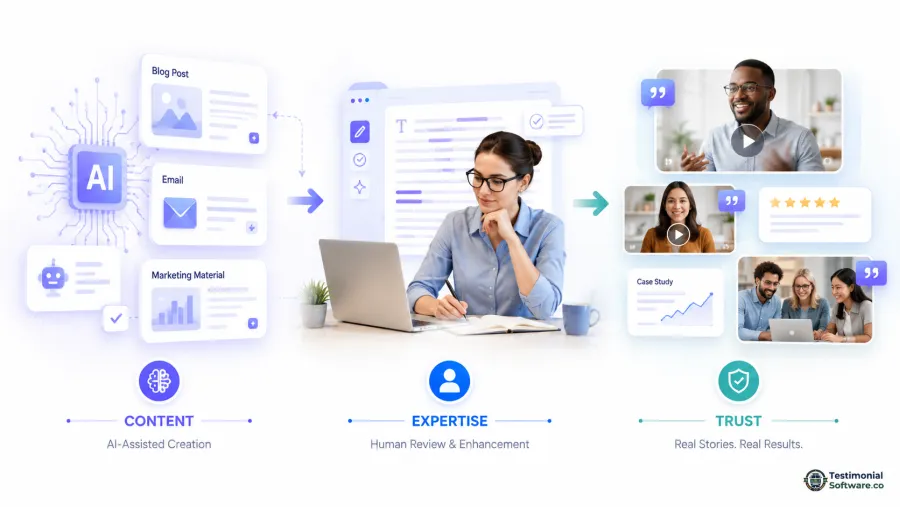
What AI cannot independently manufacture with credibility is a genuine customer’s real experience.
This may make authentic customer evidence increasingly important.
Businesses will need stronger forms of trust, including:
- Verified testimonials
- Video testimonials
- Detailed case studies
- Customer interviews
- Real product demonstrations
- Transparent reviews
- Original research
- Founder expertise
- Measurable customer outcomes
This is one of the most important long-term effects of generative AI on marketing.
AI may make content cheaper.
But by making content cheaper, it may make proof more valuable.
8. AI can increase content quantity while reducing content quality
Before generative AI, publishing fifty articles required significant effort.
That effort created a natural limitation.
Today the limitation is disappearing.
A company can produce more words than anyone has time to properly review.
This creates what might be called a content debt problem.
The company accumulates:
- Outdated pages
- Repetitive articles
- Contradictory information
- Weak product descriptions
- Incorrect facts
- Multiple pages targeting nearly identical topics
Producing content becomes easy.
Maintaining content becomes the difficult part.
Small businesses should therefore resist the idea that more publishing is always better.
A smaller library of authoritative, accurate, regularly updated content may create greater long-term value than thousands of pages created simply because AI made them inexpensive.
9. AI-generated personalization can become impersonal
One of the promises of AI is personalized communication at scale.
But there is a strange contradiction in that promise.
A message may contain a person’s name, company, job title, and industry while still feeling completely impersonal.
Customers can often recognize communication that has been generated from a template without genuine understanding of their situation.
The U.S. Small Business Administration specifically advises human review of AI-generated business materials and identifies customer trust among the risks businesses should consider when using AI. therefore distinguish between:
Personalized data
and
Personal understanding.
AI is very good at inserting information.
Trust still requires relevance.
A thoughtful three-sentence email written after understanding a customer’s problem can outperform a perfectly personalized 500-word message that feels automated.
10. Saving writing time can create more editing work
AI productivity is sometimes measured only by generation speed.
That can be misleading.
Suppose an employee takes five minutes to generate an article but then requires:
- Thirty minutes to verify facts
- Twenty minutes to remove repetition
- Fifteen minutes to correct the tone
- Twenty minutes to add original examples
The AI still saved time compared with starting from nothing.
But the true productivity gain is not “a complete article in five minutes.”
Businesses need to measure the entire workflow.
The goal should not be the fastest possible generation.
The goal should be the most efficient path to reliable, useful content.
What small businesses should use AI-generated content for
AI works particularly well when it assists a process rather than taking complete responsibility for it.
Good applications can include:
| Use case | Recommended approach |
|---|---|
| Brainstorming | Use AI to expand options, then choose strategically |
| Outlining | Let AI organize ideas supplied by your team |
| First drafts | Treat the output as editable material, not finished work |
| Repurposing | Convert original content into different formats |
| Summarization | Verify that important context was not removed |
| Editing | Use AI to improve clarity while preserving your voice |
| Product descriptions | Provide accurate product data and review every claim |
| Social content | Add genuine opinions and brand personality |
| Email variations | Test alternatives instead of automatically sending everything |
| SEO research | Use AI for exploration, then validate search intent and facts |
Higher-risk uses should receive significantly more human supervision.
These include automatically publishing legal, financial, medical, technical, safety-related, or compliance-sensitive information.
A practical AI content framework for small businesses
Small businesses do not necessarily need complicated AI policies.
They do need clear working principles.
Start with a human source
Every important piece of content should have a source of genuine knowledge.
That could be:
- An expert interview
- Customer research
- Internal data
- A real experience
- Product documentation
- A founder’s opinion
- Original research
AI can develop the material after the business establishes what is actually worth saying.
Separate writing from verification
AI may help create a sentence.
That does not make the sentence true.
Verification should be treated as a separate stage of the workflow.
Protect sensitive information
Create simple rules defining what employees should never paste into public or unapproved AI tools.
Add something that AI cannot invent
Before publishing, add at least one meaningful element that comes directly from your business.
It could be an original observation, an example, a screenshot, a case study, a customer quote, internal data, or practical experience.
Keep a human responsible for the final content
The most important question should always be:
Who takes responsibility for this page?
If nobody inside the business understands or stands behind the content, the page probably should not be published.
Measure business outcomes instead of word count
Do not measure an AI content strategy by saying:
“We published 100 articles.”
Measure:
- Qualified traffic
- Leads
- Conversions
- Newsletter subscriptions
- Customer engagement
- Sales conversations
- Brand searches
- Useful customer feedback
Publishing has never been the real business objective.
Results are.
AI has changed what valuable content means
The first generation of AI content strategies focused heavily on production.
How quickly can we write?
How much can we generate?
How many channels can we cover?
Those questions made sense when content production was expensive.
But as generative AI becomes widely available, production itself becomes less of a competitive advantage.
Almost every business can generate text.
Almost every business can create attractive images.
Almost every business can produce polished marketing messages.
The competitive advantage increasingly moves toward things that are harder to generate:
Original knowledge.
Real experience.
Customer results.
Reputation.
Trust.
Proof.
The companies that benefit most from AI may therefore not be the companies that automate everything.
They may be the companies that understand exactly what should be automated and what should remain deeply human.
Use AI to organize.
Use AI to brainstorm.
Use AI to create first drafts.
Use AI to repurpose valuable ideas.
Use AI to remove repetitive work.
But let experts provide expertise.
Let customers describe their real experiences.
Let your business develop its own opinions.
And let humans remain accountable for what the company publishes.
The future is not AI content versus human content
The debate about whether businesses should use AI-generated content is becoming less useful.
AI is already becoming part of everyday business software and workflows.
The better question is:
What role should AI play in creating trustworthy business content?
For most small businesses, the answer is likely to be a combination.
AI provides speed.
Humans provide judgment.
AI provides variations.
Humans provide direction.
AI helps structure information.
Experts provide knowledge.
Businesses make claims.
Customers provide proof.
The opportunity is enormous for small businesses willing to use these tools thoughtfully.
A company that previously could not afford consistent content marketing can now participate.
A founder with valuable knowledge but limited writing experience can publish useful ideas.
A small team can compete more effectively for attention.
But the businesses that simply use AI to fill the internet with more words may discover that producing content and earning trust are two completely different problems.
Generative AI has made content creation easier than at any previous point in the internet era.
That makes the remaining challenge much clearer.
The future of successful content marketing may depend less on how much a business can generate and more on how much of what it publishes people can genuinely believe.
Frequently Asked Questions
How has AI-generated content helped small businesses?
AI-generated content can help small businesses reduce the time required for brainstorming, drafting, editing, repurposing, and preparing marketing materials. This allows smaller teams to maintain a more consistent content presence without requiring a large dedicated marketing department.
What are the main disadvantages of AI-generated content?
The main risks include inaccurate information, generic writing, loss of brand voice, privacy concerns, intellectual-property questions, excessive low-quality content, and reduced customer trust. These risks increase when businesses publish AI output without adequate human review.
Does Google penalize AI-generated content?
Google’s published guidance focuses on the quality and value of content rather than simply whether AI was involved in creating it. However, using automation or generative AI to produce large numbers of pages without adding value may violate Google’s policies concerning scaled content abuse. Businesses should prioritize accurate, useful, relevant, and original content rather than mass production. siness use AI to write blog posts?
Yes. AI can be particularly useful for developing outlines, creating first drafts, reorganizing expert knowledge, improving readability, and repurposing existing content. The strongest results usually come when the business contributes original expertise and a human reviews the final article before publication.
Is AI-generated content protected by copyright?
The answer depends on the jurisdiction and how the work was created. In the United States, the Copyright Office has stated that copyright protection depends on sufficient human authorship. Human-created selection, arrangement, or modification may be protectable, while merely providing prompts does not automatically create copyright protection over machine-determined expressive elements. ses tell customers when they use AI?
There is no single universal rule that applies to every type of AI-assisted business content. The appropriate level of transparency can depend on the context, applicable regulations, the type of content, and customer expectations. Businesses should be particularly careful where AI-generated material could be mistaken for a real person’s experience, professional advice, or independently verified information.
Will AI replace content writers for small businesses?
AI is more likely to change the work involved in content creation than eliminate the need for human input entirely. Drafting may become faster, while research, interviewing, fact-checking, strategy, original thinking, editing, and brand differentiation become more important.
Why could customer testimonials become more important because of AI?
Generative AI makes company-created marketing claims inexpensive to produce. As polished content becomes easier for almost any company to create, prospective customers may place greater value on credible evidence from people who have actually used a product or service. Authentic testimonials, customer stories, case studies, and measurable results can help provide the proof behind marketing claims.
Sources and further reading
- U.S. Small Business Administration — AI for Small Business
- U.S. Chamber of Commerce — Empowering Small Business: The Impact of Technology on U.S. Small Business
- Google Search Central — Guidance on Using Generative AI Content on Your Website
- Federal Trade Commission — AI Companies: Uphold Your Privacy and Confidentiality Commitments
- U.S. Copyright Office — Copyright and Artificial Intelligence, Part 2: Copyrightability
Venkat